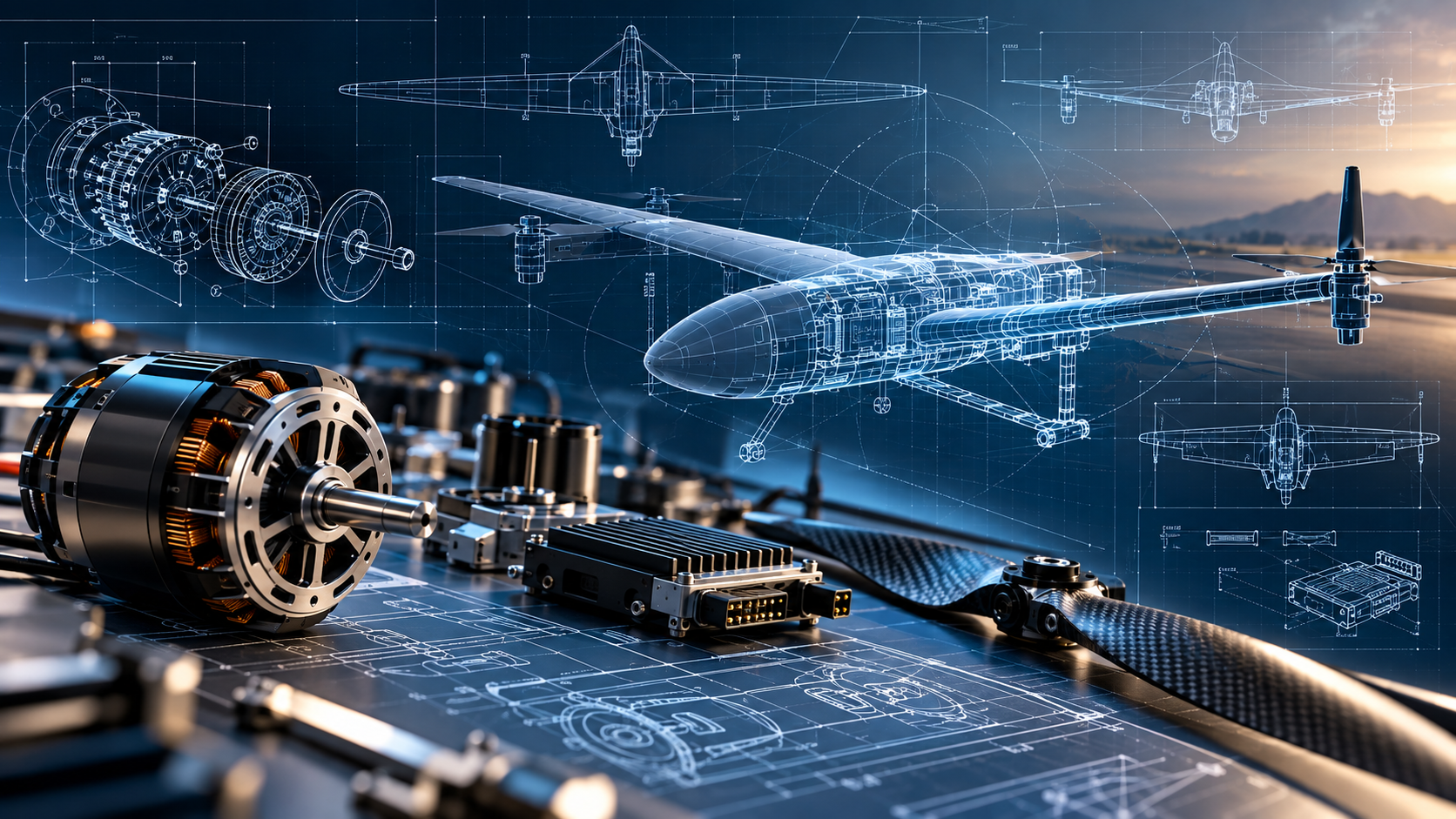
Building an autonomous platform often starts with a familiar process: find a motor that meets the thrust requirement, source an ESC that can handle the current, choose a propeller that fits the application, connect everything together, and start testing.
On paper, every component might meet its individual specification. In the air, things can look very different.
Electric propulsion is an interconnected system. Motors, electronic speed controllers, propellers, batteries, thermal management, control strategies, and the aircraft itself all influence how efficiently and reliably power becomes thrust. That means the best-performing component on a spec sheet is not always the best-performing component within the system.
And as autonomous platforms become more capable, the cost of taking a patchwork approach to propulsion becomes harder to ignore.
A motor does not operate independently. Neither does an ESC or propeller. Each changes the operating conditions of the others.
A 2025 study published in Drones examining multirotor electric propulsion reliability emphasized just how central propulsion is to overall aircraft reliability, noting that the reliability of the electric propulsion system directly affects whether a drone can successfully complete its mission.
The interaction begins at the most fundamental level. The propeller determines the aerodynamic load placed on the motor. The motor's operating characteristics determine current demand and thermal behavior. The ESC has to deliver and control that power effectively across changing operating conditions. Battery voltage and available power affect the entire chain.
Change one variable and the effects can travel through the entire propulsion architecture. That's where a collection of individually capable components can become a system-level compromise.
Using different suppliers for the motor, ESC, propeller, and other propulsion components can give engineers flexibility, especially during early prototyping. But it can also transfer the burden of system integration directly onto the platform developer.
Engineering teams have to determine whether components that were designed and validated independently will operate optimally together. That can mean additional:
And the consequences of imperfect matching are not limited to whether the aircraft flies. They can show up as unnecessary heat, current draw, vibration, reduced efficiency, shortened component life, inconsistent throttle response, or lost endurance.
Recent research demonstrates just how interconnected motor and ESC behavior can be. An August 2026 study on BLDC drone propulsion performance incorporated actual ESC drive-current characteristics and mechanical losses into motor performance modeling. By treating those real operating conditions as part of the propulsion problem, researchers reduced input-power prediction error from 26.61% to 2.62% and efficiency prediction error from 36.27 percentage points to 2.55 percentage points.
The takeaway goes beyond the specific modeling methodology. How a motor performs cannot be fully understood without understanding the system operating around it.
Instead of asking whether each individual component meets a requirement, an integrated approach starts with a different question: What does the aircraft need the propulsion system to accomplish?
Payload. Endurance. Thrust. Speed. Thermal performance. Operating environment. Size and weight. Duty cycle. Mission profile.
Once those requirements are understood, the motor, controller, propeller, and surrounding architecture can be selected or engineered as parts of the same solution.
Recent propulsion research reinforces the importance of that system-level view. An August 2026 study examining BLDC propulsion performance found that incorporating actual ESC drive characteristics and mechanical losses substantially improved the accuracy of motor performance and efficiency predictions.
The broader takeaway is important for autonomous platform developers: motor performance cannot be evaluated in isolation from the components and operating conditions surrounding it. An integrated approach allows engineers to consider those interactions earlier, optimizing propulsion around the aircraft's actual mission requirements rather than assembling individually selected components and solving compatibility issues later.
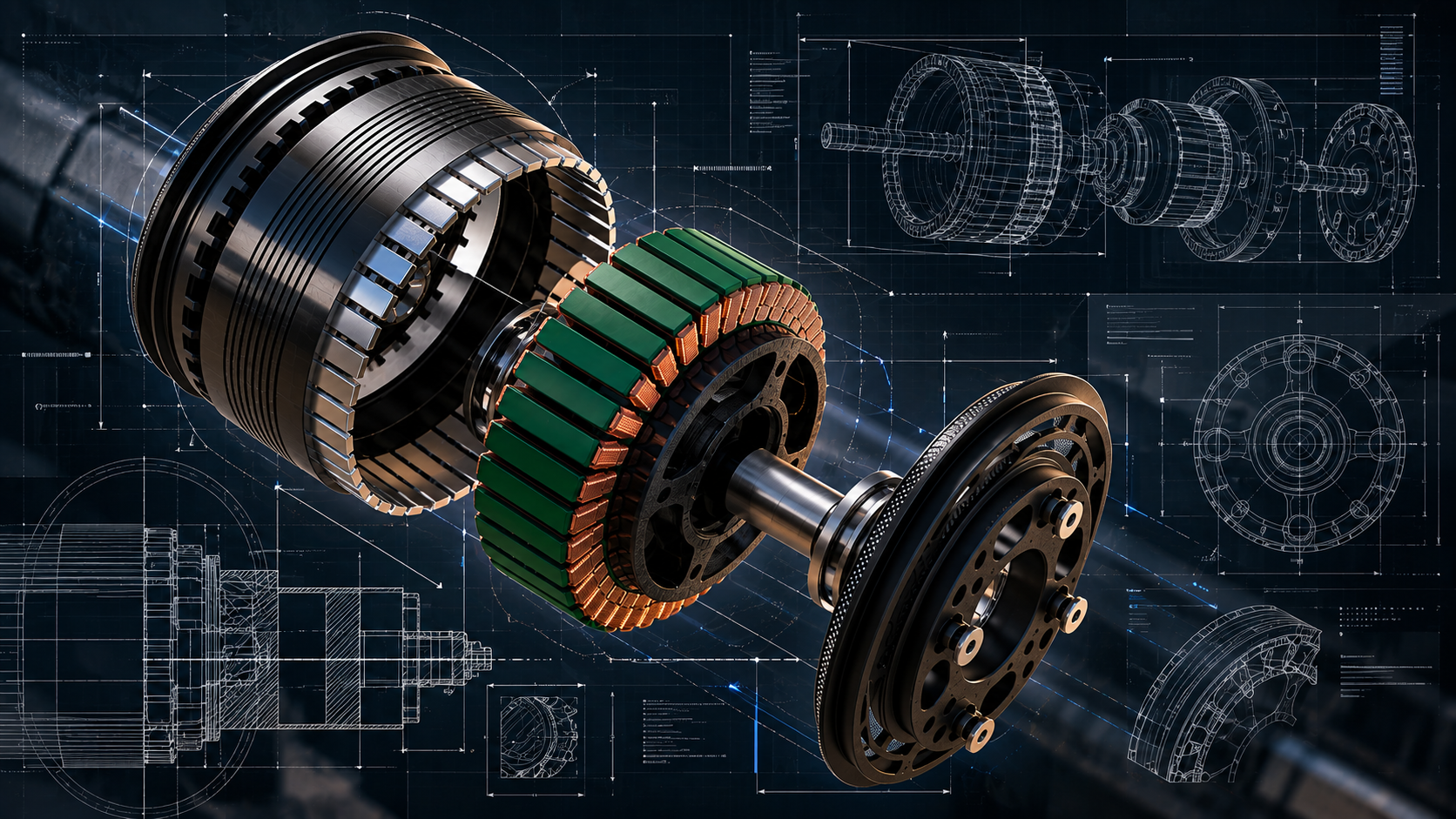
CR Systems approaches propulsion as a system problem rather than simply a motor problem. Its integrated propulsion portfolio includes motors, electronic propulsion units (EPUs), propellers, and electronic speed controllers engineered around the performance, reliability, and operational requirements of uncrewed and autonomous platforms.
But integration does not always mean starting from scratch. CR Systems offers more than 100 production-ready UAV motors alongside FPV and Group 1 propulsion kits, giving platform developers the ability to move quickly when an existing solution fits the mission.
When it doesn't, the approach changes. CR Systems engineers work directly with integrators and platform developers to adapt proven architectures or develop custom propulsion configurations around specific payload, thrust, efficiency, thermal, and operational requirements.
That flexibility matters because there is no universal propulsion architecture for autonomy. A Group 1 aircraft, heavy-lift logistics platform, maritime autonomous system, and industrial robotic platform may all require fundamentally different approaches to converting electrical power into useful work.
The goal isn't integration for integration's sake. It is making sure the propulsion architecture is optimized around the platform and the mission.
The propulsion patchwork can become even more difficult when a program moves from prototype to production. A combination of components that works for five aircraft must still work for 50, 500, or potentially thousands.
That introduces another layer of questions. Can every component be sourced consistently? Can manufacturing tolerances be maintained? Will substitutions change system performance? Can the same configuration be reproduced reliably? Who owns troubleshooting when an issue involves multiple components from multiple suppliers?
For autonomous platform manufacturers, reducing the number of disconnected variables in the propulsion architecture can simplify not only engineering, but also procurement, production, testing, and long-term support.
CR Systems supports customers from initial development through volume production, pairing engineering expertise with flexible manufacturing and production-ready propulsion solutions designed to scale alongside the platforms they power.
There will always be a place for individual motors, controllers, propellers, and other off-the-shelf components. The important question is whether those components have been selected and validated based on how they perform together.
As autonomous platforms take on longer missions, heavier payloads, more demanding operating conditions, and increasingly critical applications, propulsion optimization becomes less about finding the strongest motor or the largest propeller. It becomes about finding the right combination.
Because the objective isn't to build a collection of good components. It's to build one propulsion system that works as a system.