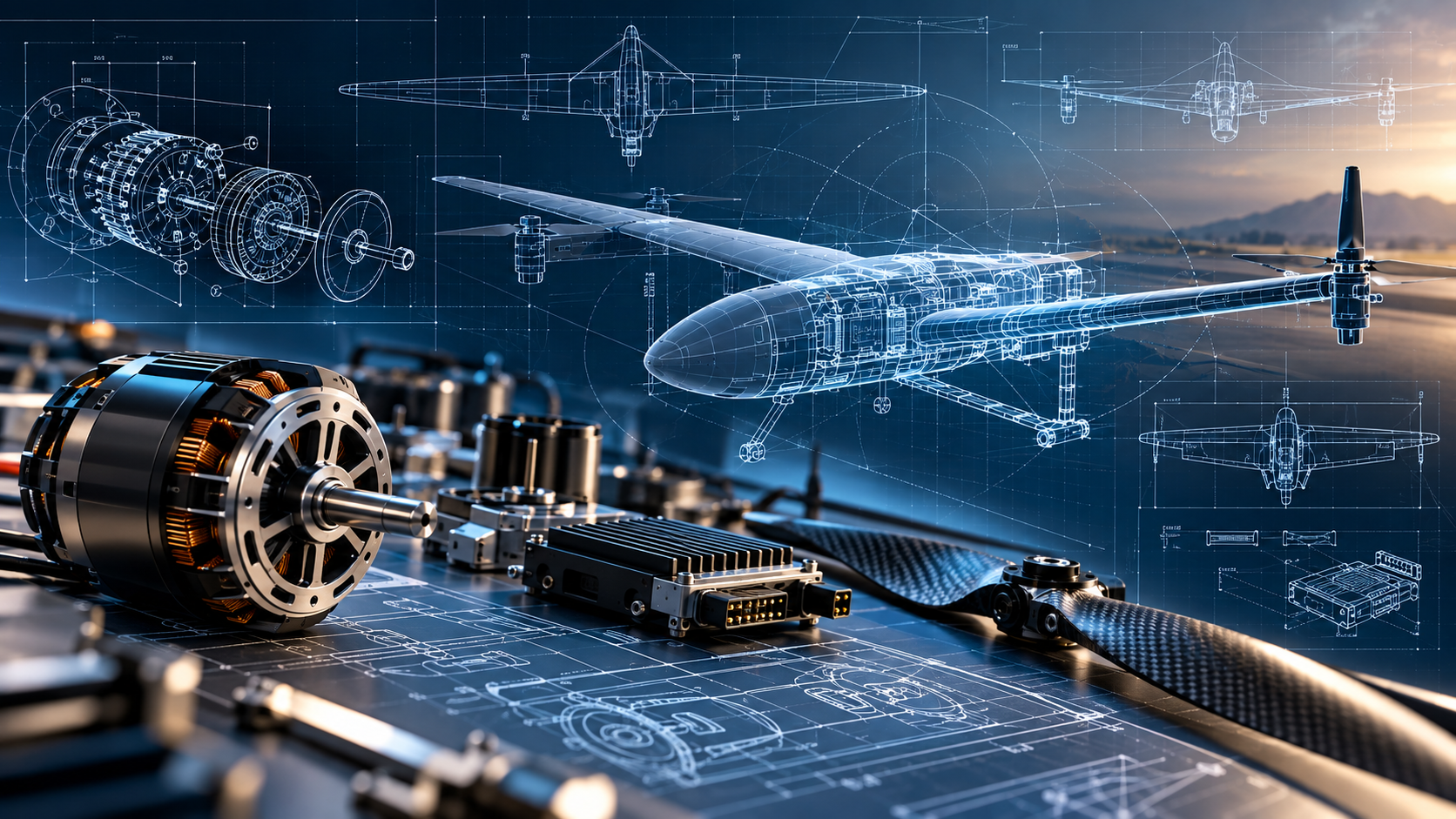
The unmanned aircraft systems being developed today may look very different from those operating a decade from now.
Autonomous platforms are being asked to fly longer, carry more, operate in more demanding environments, and perform increasingly complex missions. At the same time, manufacturers are facing pressure to move from prototype to production faster while navigating evolving supply chain and compliance requirements.
For UAS builders, preparing for the next decade is not simply about predicting the next technology breakthrough. It is about designing platforms that can adapt.
From propulsion and endurance to manufacturing and sourcing, several considerations are becoming increasingly important for the next generation of autonomous systems.
Electric propulsion has already transformed the UAS industry, particularly for smaller platforms where simplicity, responsiveness, reduced maintenance, and efficient power delivery make electric motors a natural fit. But electrification is not one single architecture.
Battery-electric, hybrid-electric, hydrogen fuel cell, and other emerging energy systems are all being explored as engineers attempt to extend the capabilities of autonomous aircraft.
A 2026 U.S. Government Accountability Office report on electric aircraft noted that manufacturers are developing both fully electric and hybrid-electric aircraft for a growing range of applications, including cargo transport. The report also highlighted ongoing work to enable longer-range electric operations.
For UAS manufacturers, the important takeaway is not that one power source will ultimately replace every other. Different missions will continue to require different solutions. That means propulsion architectures need to be flexible enough to evolve with the platform.
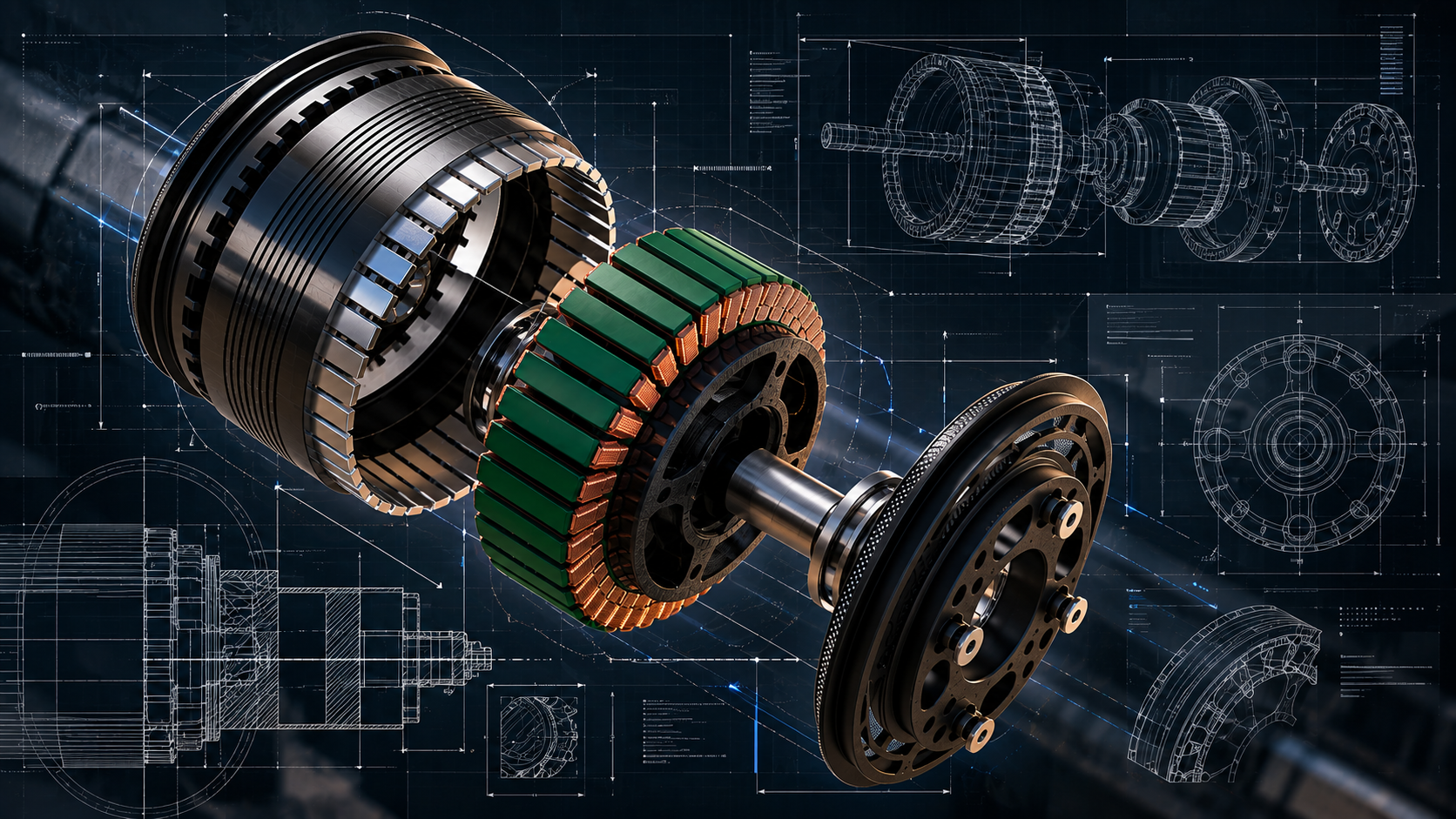
CR Systems approaches propulsion from this perspective, offering everything from production-ready electric motors to integrated electronic propulsion units and custom systems developed around the power, payload, thermal, and operational requirements of a specific aircraft. The objective is not simply to find a motor that works today. It is to build a propulsion architecture capable of supporting where the aircraft goes next.
Few UAS performance metrics are discussed more frequently than endurance. Every additional minute in the air can expand what an autonomous platform can accomplish, whether that means covering more territory, transporting cargo farther, maintaining surveillance longer, or reducing the number of launch and recovery cycles required during a mission.
Recent research continues to demonstrate how much opportunity remains. A June 2026 study published in the Journal of Energy Storage comparing battery-electric and hydrogen fuel cell propulsion found that the optimal power system depended heavily on the mission. Lithium-ion batteries performed well for shorter-duration operations, while hydrogen fuel cells offered endurance advantages as mission duration increased.
Other research is looking beyond the energy source itself. An August 2026 study published in Applied Energy demonstrated that combining high-fidelity powertrain modeling with optimized flight strategies reduced total mission energy consumption by 23.1% in the scenario studied.
The larger lesson is significant: The next gains in endurance will not necessarily come from one breakthrough component. They will come from optimizing the entire system.
Motor efficiency, propeller selection, electronic control, aircraft weight, thermal performance, energy storage, flight profile, and payload all interact. Even seemingly simple decisions can have measurable consequences. A 2026 experimental study of UAV electric powertrains found meaningful differences in thrust efficiency and endurance simply by changing propeller configurations while keeping the battery, ESC, and motor constant.
For manufacturers, that reinforces the value of treating propulsion as a complete architecture rather than a collection of independent parts.
One of the biggest challenges facing the autonomous systems industry is moving successfully from development into repeatable production. A platform that performs beautifully as a prototype still needs to be manufactured consistently, reliably, and potentially in large quantities.
That challenge is receiving increasing attention across the U.S. autonomous systems ecosystem. In July 2026, Carnegie Mellon University announced a new initiative focused specifically on scaling U.S. autonomous systems manufacturing. The program combines robotics, automation, advanced manufacturing, and commercialization capabilities with the goal of helping U.S. drone manufacturers increase production.
The emphasis on manufacturing scale represents an important change in the industry. Engineering teams increasingly need to ask production questions while platforms are still being designed. Can the components be manufactured repeatedly? Are suppliers capable of supporting increased demand? Will specifications remain consistent across production runs? Can the propulsion architecture move from tens of aircraft to hundreds or thousands without major redesign?
CR Systems has built its propulsion model around both development and production. Its portfolio includes more than 100 tested, production-ready motors for platforms ranging from FPV and Group 1 UAS through heavy-lift applications, while its engineering team can also modify proven architectures or develop custom propulsion systems when an off-the-shelf solution does not meet the mission.
That combination allows manufacturers to move quickly without losing the ability to optimize as programs mature.
Performance and manufacturability are only part of the equation. Where components come from is becoming increasingly important as well.
In August 2026, a White House proclamation addressing UAS and UAS component imports concluded that U.S. manufacturers remain too dependent on foreign sources for both finished aircraft and critical UAS components. Among the components specifically identified were motors and electronic speed controllers.
The proclamation also concluded that domestic UAS manufacturing capacity needs to grow rapidly to support anticipated military and commercial demand. For UAS builders, this means component sourcing should increasingly be considered during architecture development rather than after the platform has already been designed.
That is particularly relevant for manufacturers pursuing defense and government opportunities, where NDAA compliance can influence supplier and component decisions.
CR Systems designs and manufactures NDAA-compliant electric propulsion systems for uncrewed and autonomous platforms, allowing manufacturers to consider propulsion performance and compliant sourcing together from the beginning of a program. As requirements continue to evolve, designing around a trusted supply chain today can reduce the likelihood of disruptive supplier changes or redesigns tomorrow.
Perhaps the greatest challenge facing UAS manufacturers is that the mission itself is changing. Autonomous aircraft are moving well beyond traditional aerial imaging and reconnaissance.
Platforms are increasingly being developed for logistics, heavy lift, infrastructure inspection, disaster response, maritime operations, defense, persistent observation, and other applications that place very different demands on the propulsion system. A long-endurance surveillance aircraft and a heavy-lift logistics vehicle may both be autonomous UAS, but their propulsion requirements are fundamentally different.
That makes designing around the mission profile increasingly important. Payload, flight duration, environmental conditions, altitude, acoustic requirements, thermal load, redundancy, speed, and duty cycle all influence what the right propulsion solution looks like.
There will not be one motor or one propulsion architecture that defines the next decade of autonomy. There will be platforms engineered around increasingly specialized missions.
CR Systems' role as a propulsion solution center is built around that reality. Its engineers work directly with platform developers to adapt existing motor architectures, integrate propulsion components, or develop custom electromagnetic systems when mission requirements demand something different.
For heavy-lift and logistics applications, that also includes CR Systems' patented eVector technology, which uses counter-rotating propellers and advanced motor architecture to increase thrust while improving efficiency and thermal performance.
Predicting exactly what autonomous aircraft will look like in 2036 is impossible. But the direction of the industry is becoming clearer.
Platforms will need to operate longer. They will need to carry more. They will need to move from development to production faster. They will need resilient, trusted supply chains. And they will need propulsion systems capable of adapting to mission requirements that are still evolving.
For UAS manufacturers, the best way to prepare for that future may not be to predict every technology that comes next. It may be to make better architectural decisions today.
Choose components that can scale. Think about compliance early. Optimize propulsion as a system. Design around the mission rather than a single specification. And work with engineering partners capable of adapting as the aircraft evolves.
Because the most valuable autonomous platforms of the next decade will not simply be the ones designed for today's requirements. They will be the ones built to handle what comes next.